
During my internship, I had the chance to work on a VR game project and create several 3D models from scratch. It was my first time experiencing a full game asset pipeline, and honestly, it taught me more than any tutorial ever could. I wasn’t just trying to make things look good — I also had to think about performance, optimization, and how these models would actually behave inside a real game.
Palm Tree
One of the first models I worked on was a stylized palm tree. I started by sculpting a high-poly version in ZBrush to capture that soft, organic look. After I was happy with the shape, I moved into Blender for retopology and created a clean low-poly version that could run smoothly in the engine. Then came the baking process, where all those high-poly details were transferred onto the low-poly mesh, and finally I textured everything in Substance Painter. Seeing the finished result in the game was a great feeling — it looked polished, but it was still lightweight and practical.


Rocks
Another fun challenge was creating a set of rock models for the environment. There were four different rocks, but together they were only 120 polygons in total. That was a real lesson in how much you can achieve with good baking and texturing. I sculpted the original forms in ZBrush, did the retopology in Blender, and handled all the textures in Substance Painter. Even with such low geometry, they ended up looking surprisingly detailed inside the game.
Enemy Unit-Gigajaw
I also had the opportunity to create an enemy character called GigaJaw for the project Island Defender. He’s an undead flying creature designed to rush the player as soon as he spawns. Just like the other assets, I sculpted him in ZBrush, retopologized in Blender, and textured in Substance Painter. The final model was 1179 polygons — optimized enough for real-time use but still expressive and a bit scary, which was exactly what I wanted.

Shelter
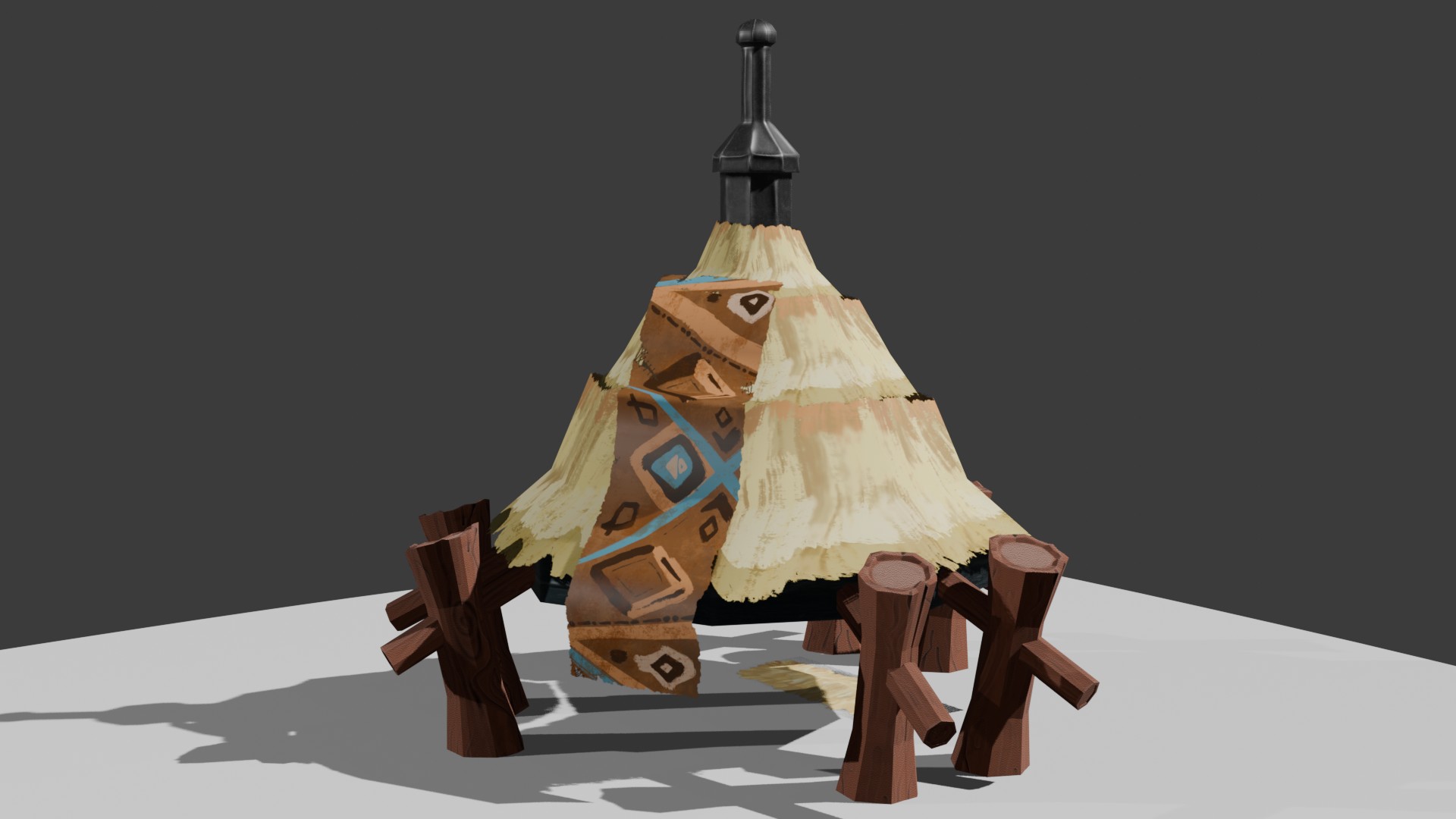
The last major asset I worked on was a shelter structure for the same game. This one was a mix of techniques: parts like the roof, the flag, and the bed inside were hand-painted, while the logs and metal pieces followed the sculpt–retopo–texture workflow. With all its pieces combined, the model ended up at 2126 polygons and was designed to be modular so it could be reused in different parts of the level.
Comments